
Is it true that most resident doctors really oppose the strikes?
14 November 2025

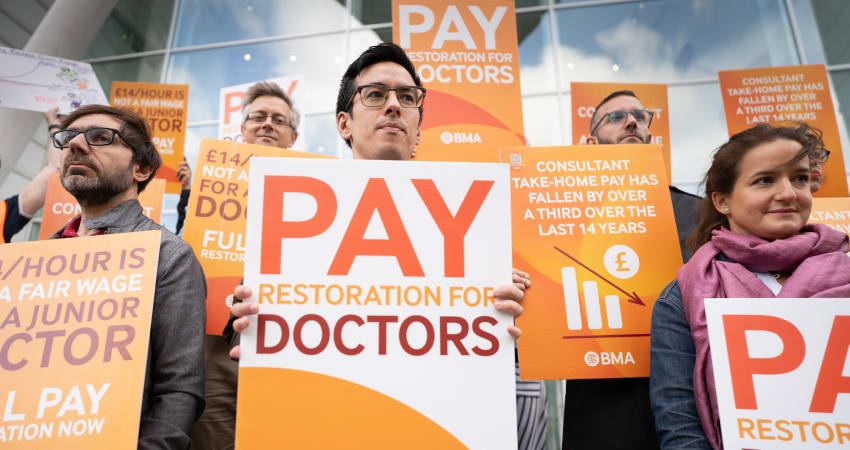 Credit: PA/Stefan Rousseau
By Claudia Tanner
Most resident doctors do not support strike action with only a third for it, according to a Times article.
A survey by Savanta has intensified criticism of the BMA's decision to proceed with walkouts, with the results providing ammunition for the health secretary to yet again attack the union’s leadership, accusing them of being "out of touch with frontline doctors" and going "against the wishes of members".
Wes Streeting told the newspaper: “Patients don’t want the strikes to go ahead, and now it’s apparent that resident doctors don’t either – yet the BMA rejected the government’s offer out of hand.”
But the union has fired back, arguing that the poll sample of just 202 doctors – including just 102 BMA members – is too small to reflect the views of the UK's 77,000 resident doctors.
The poll was conducted over the past week, asking doctors whether they agreed the BMA should call off planned strikes if the government introduced measures offered by Streeting.
The survey found that 48 per cent of respondents wanted the strike called off after Mr Streeting offered a package of reforms, whilst only 33 per cent supported going ahead with the walkout. The remaining 19 per cent were unsure about the action, which began at 7am on Friday.
Dr Jack Fletcher, BMA resident doctor committee chair, dismissed the findings as "far too small to draw meaningful conclusions," calling it a "weak attempt at polling" that fails to capture doctors' genuine frustrations about the jobs and training crisis.
He added: “Support for industrial action has already been decisively demonstrated through 30,000 resident doctors voting to take industrial action, and from discussions taking place in doctors’ offices, WhatsApp groups and online.”
Critics point out that there has been a fall in turnout in strike ballots. The latest one, which closed in July providing a six-month mandate for strike action, had a turnout of 55 per cent, down from 78 per cent in 2023.
Some 90 per cent voted in favour of industrial action in July providing a six-month mandate for the move. But critics point out turnout was only 55 per cent, scraping above the 50 per cent legal threshold for calling strike action and meaning just under half of resident doctors in the BMA have actually voted in favour of strike action (49.78%).
The BMA launched a second ballot of first year doctors (FY1s) in autumn which saw 97% (or 3,950) of resident doctors voting for strike action on a turnout of 65%, providing them with a mandate for action,
However, the government argues that in June 2025 there were over 8,200 FY1 doctors working in NHS Hospital Trusts. “With only 3,950 voting in favour of a strike, based on these figures, under half (48%) of FY1s voted to strike in the FY1 ballot,” it states.
Promises to improve conditions - but not pay
The health secretary has offered to pay resident doctors’ exam fees in a last-ditch attempt to avert industrial action.
However, he said he could “not go further on pay” this year because doctors have already received an average 28.9 per cent uplift in their wages over the past three years.
The union is demanding “full pay restoration”, equivalent to a 29 per cent rise.
Mr Streeting promised the government will pay for exams that have already been taken this financial year, backdating the payments to April.
He vowed to address “training bottlenecks” and help resolve the unemployment woes resident doctors are facing by increasing the number of speciality places available, expanding the number to 2,000 over the next 3 years. He promised to bring forward 1,000 of these places for this year’s application window.
He also pledged to kickstart plans to prioritise UK graduates over overseas students for the limited spaces.
But the estimated quarter of a billion cost of the strikes hinders what’s on offer, says Mr Streeting.
“By walking out on strike, the BMA are walking away from an offer to improve resident doctors’ working conditions and create more specialty training roles to progress their careers,” state the Department of Health and Social Care.
Government ‘gaslighting’ doctors
Dr Fletcher accused NHS managers of “emotionally blackmailing frontline staff who are taking legitimate industrial action to defend their pay and conditions, and fight for employment”.
He told PA that strikes “have not come out of the blue”, adding: “What has been offered so far still leaves thousands of resident doctors without a role this year, and the government seems determined to cut pay even further next year.”
Dr Fletcher said “any resident doctor” would challenge the narrative that the NHS is “somehow turning a corner”.
“We have doctors sitting on bins because there aren’t enough chairs, patients routinely being seen in corridors, A&E waits through the roof and rota gaps are an accepted norm,” he said.
“We cannot let the government and managers gaslight the public into putting the blame for these system-wide failures at the doors of hardworking doctors who are standing up for their profession and the future of the health service.”
You might also like