8 October 2024
Getty/ThamKCBy Olivia Bowthorpe
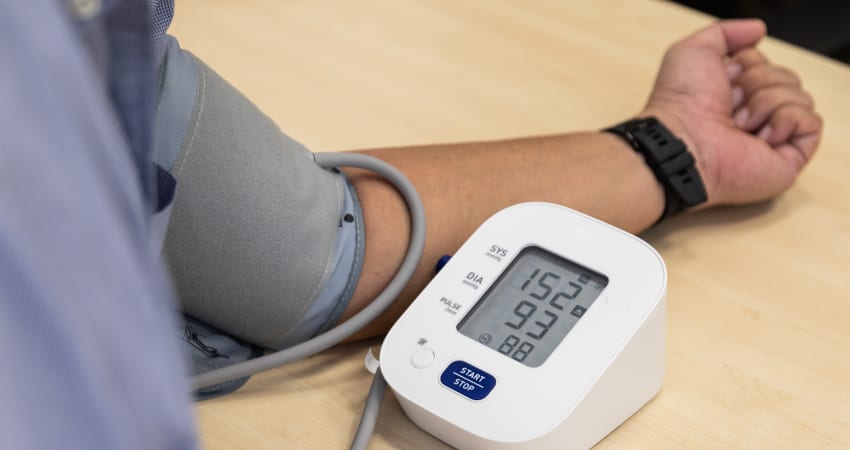
Blood pressure readings should be taken using the correct arm position to avoid inaccurate results and potential misdiagnosis, researchers have warned.
Compared to the recommended position with the patient's arm supported and the cuff level with the heart, other positions "resulted in substantial overestimation of blood pressure readings", the study found.1
Dr Tammy Brady, associate professor of paediatrics at Johns Hopkins University School of Medicine, Baltimore, US, and her team used a crossover design for their study of 133 adults in Baltimore, Maryland.
Each participant had blood pressure readings taken with their arm supported on a desk, with their hand on their lap, and with their arm hanging unsupported at their side.
Results showed that lap and side positions resulted in statistically significant higher blood pressure readings than the desk position.
Full details appear in JAMA Internal Medicine. The team report that not adhering to the guideline-recommended arm position during blood pressure measurement resulted in overestimation by 4 to 10 mm Hg, a result "sufficiently high to raise concerns for overdiagnosis and overtreatment".
They add that the patterns were generally consistent across subgroups, but were more extreme among higher-risk groups. Systolic blood pressure was overestimated by about 9 mm Hg among those with hypertensive blood pressure when their arm was hanging at the side.
"We demonstrate that when the arm is completely unsupported and hanging at the side, as is often the case when arm support on a desk or chair is not possible or when a patient is seated on the examination table in a clinic room, blood pressure is greatly overestimated," they write.
"Furthermore, positioning the arm in the lap, a typical compromise for the above scenarios, also results in considerable overestimation. Thus, these arm positions should not be used, even in the setting of limited time or resources."
Although clinical guidelines emphasise positioning the arm at heart level with support, this practice is often overlooked in clinical settings.
Dr Brady and colleagues believe: "Several factors contribute to this discrepancy: lack of health care professional awareness about the effect of arm position on measurement accuracy, as well as limitations in training, resources, and equipment, particularly in resource-limited environments."
They calculated that in the US, improper arm position could result in 16% of adults being misclassified as hypertensive when using a systolic blood pressure cutoff of 140 mm Hg and higher, and 22% being misclassified when using a cutoff of 130 mm Hg and higher.
"Considering the varied health care practices, equipment standards, and training levels across different countries, the likelihood of misdiagnosis could be even greater," they add.
This study used only one oscillometric device, the ProBP 2000 Digital Blood Pressure Device made by Welch Allyn, so may not be generalisable to other products. Furthermore, the numbers of participants in certain age, weight, and frequency of health care utilisation subgroups were small.
Current guidance from the National Institute for Health and Care Excellence recommends measuring blood pressure "in a relaxed, temperate setting, with the person quiet and seated and their arm outstretched and supported", but does not mention placing the cuff at heart level.2