
The medical A-Z of 2023: the biggest stories of the year
29 December 2023

 iStock.com/sturti/Akarawut L./izusek and image by Ellie Philpotts
By Stephen Robinson
It wouldn’t be December without an end-of-year review. Here we journey through some of the highlights - and lowlights - of a turbulent year in the medical world and discover our most-discussed story of 2023.
A is for… Associates under the spotlight
All eyes in medicine were on medical associate professions (MAPs) this year, sparking an impassioned debate.
Despite MAPs being part of the NHS for the past two decades, their formal regulation has been very slow to arrive. This year saw escalating concerns from doctors over perceived ‘scope creep’, patient safety fears, potential patient confusion over the physician associate title and debates over General Medical Council (GMC) regulation.
It prompted protest votes in the autumn at a royal college EGM, a significant BMA intervention, the promise of imminent talks with the NHS and a pledge of new guidance for employers.
This debate is not going away: expect pressure on the government, GMC - and perhaps royal colleges as well - to mount in 2024.
B is for… Burnout looms large yet again
Another year, another GMC survey of trainees showing record levels of burnout among our youngest doctors (23% at high risk, up from 19% last year), as well as their trainers (12%).
More trainees felt their work was emotionally exhausting. More found every working hour tiring. More said their work frustrated them. More always or often felt worn out at the end of the day.
As long as this trend continues, the NHS will be stacking up problems for the future of its workforce.
Remember that there is support available if you are struggling.
C is for… Covid inquiry rumbles on
Though it opened in June 2022, this year saw the first public hearings of the UK Covid-19 Inquiry. Prime Minister Rishi Sunak, former prime minister Boris Johnson, former health secretary Matt Hancock, former NHS England chief Sir Simon Stevens, chief scientific adviser Sir Patrick Vallance and BMA chair Professor Philip Banfield have all given evidence so far, among others.
The inquiry aims to “learn lessons for the future” by examining the UK’s response to the pandemic.
Earlier this year, experts and doctors cast doubt over the UK’s preparedness just a few years on from Covid-19. Foremost among their concerns is how an even more stretched NHS would cope if a pandemic disease were to arise again soon.
As for the inquiry, don’t hold your breath for an outcome any time soon - by all accounts, it’s likely to run until at least 2027. Let’s just hope there isn’t a new pandemic before then.

iStock.com/ shih-wei
D is for… Debt from mandatory exam fees
“I've had to put my exams on my credit card,” anaesthetics trainee Dr Karim Salem told us in August. “I’ve also had to borrow money from my parents - I literally needed it to be able to pay for my kids to eat - and it means I’m in an extremely precarious position.”
Amid the spectre of high inflation, we found many doctors struggling under the weight of exam fees, including the burden of resits, hidden costs from travel and accommodation, extra courses and revision papers.
So it was quite surprising when we found some colleges making surpluses from these exam fees, leading to accusations they were using trainees as a “cash cow”. The colleges maintained any surpluses were reinvested in college activities.
E is for… Empathy lessons needed?
Are all doctors empathetic enough?
Perhaps not: and this year a study suggested a “hidden curriculum” in medical school may be to blame, reducing students’ empathy.
The research, published in BMC Medical Education, aimed to systematically show why empathy declines during medical training.
The curriculum includes “subtle, non-formal influences over students”, according to researchers - for instance, prioritising the biomedical model of disease - a mechanistic view - over “the ‘biopsychosocial’ model of disease, which includes biological, psychological and social factors”.
It suggested a rethink is needed for how we train our doctors, given how important empathy is in delivering safe, effective care and improving patient quality of life.

iStock.com/ oatawa
F is for… F3 breaks become the norm
Most doctors are now taking a year out after foundation training - a stark change from the 17% who did in 2010.
So in September, we spoke to trainees about why they’d chosen an F3 year - and what their top tips are for those considering one.
“It’s probably the healthiest I’ve felt… it was all a bit more balanced,” according to Dr Shahin Ghezelayagh, ST3 registrar in clinical oncology in Kent.
G is for… General practice set for a shake-up - if Labour wins in 2024/25
While the Conservatives and the Prime Minister focused on cutting waiting lists as their key NHS-related pledge in 2023, Labour has been promoting its policies for the health service ahead of what is likely to be an election year in 2024.
Quite a few are aimed at reforming primary care. From controversial plans in January to abolish GP partnerships, later abandoned, to its baffling scheme to bypass GPs altogether and allow patients to self-refer to specialists for some conditions.
Perhaps the biggest proposal was the introduction of at least 42 neighbourhood walk-in health centres across England, which can see patients in evenings and on weekends, based on a similar approach in Australia.
The party also pledged to bring back the “family doctor” - though GP leaders warned this would prove impossible without massive improvements in recruitment.
Shadow health secretary Wes Streeting even took aim at proposals from the Royal College of General Practitioners to save general practice, telling leaders they are "blocking progress".
Meanwhile, for the rest of the NHS, Labour plans new league tables, a £1.1 billion fund to help pay for higher overtime payments, such as weekend shifts, to clear the backlog, along with further “deep, long term changes” to prevent ill health and make better use of technology.
H is for… Health secretary ‘revolving door’
Just the two health secretaries this year - a relatively quiet period compared with the FOUR changes in the role last year (for those taking notes: Sajid Javid, then Steve Barclay, then Thérèse Coffey, then Barclay again).
Victoria Akins is the latest incumbent after Barclay was moved to the Department for Environment, Food and Rural Affairs in the September reshuffle.
She inherited a pay dispute with unions, worsening NHS waiting lists, a workforce crisis and poor public health post-pandemic.
Time will tell how much of her own priorities she’s able to pursue before the general election, expected next year.

iStock.com/ Kwangmoozaa
I is for… Infectious diseases due to global heating
The impact of the climate crisis on the world’s health will be profound. One of the emerging risks is the spread of tropical diseases once confined to southern climes making it into northern parts of Europe as the continent warms.
Though more than a century has now passed since the last malaria outbreak in the UK, a warming world threatens a troubling resurgence of this now-banished disease.
In August, during what is expected to be the hottest year on record, we looked at the possible threat from mosquito-borne diseases in the UK, and what it may mean for our health in just a few decades’ time.
And earlier this month, the UK Health Security Agency warned the UK could be infested with disease-bearing mosquitoes within 20 years if the world fails to slow the process of climate change.
J is for… Journeying to Jura with the GP Nomad
In August, our travelling GP continued his story with a journey to the remote Hebridean isle of Jura, yet another picturesque Scottish island, where he faced the question of whether he had the skills to cope with a lacerated thumb.
It was the 11th instalment of our series about the intrepid medical wanderer, who has so far battled Storm Ciara on a remote island to airlift an emergency patient to safety, assisted in a delivery, navigated the pandemic and been the onboard doctor for a 5,000-mile journey on the luxurious Trans-Siberian Express.
K is for… Kindness towards colleagues - or face the GMC?
Good Medical Practice is receiving a substantial update at the end of January - the first in 10 years - but when the changes were first announced in August, inclusion of the word ‘kindness’ caused quite a stir.
Several prominent doctors queried a section that requires doctors to treat colleagues and patients with “kindness, courtesy and respect”. The GMC said this can “profoundly shape” patients’ experience of care.
One questioned whether a doctor could be in breach of good medical practice simply by questioning a staff member’s attitude or ability.
Meanwhile, the Medical Defence Union warned that only half of doctors it surveyed said they would have time to "fully absorb" the new guidelines before they come into force on 30 January 2024.

iStock.com/ KrizzDaPaul
L is for… Lipid therapy for all?
We moved another step closer to blanket statin treatment for most adults when NICE announced in January it was once again seeking to recommend a lowering of the threshold for offering statins.
But questions soon emerged over whether such a policy would be deliverable - given it could make an extra 15 million people eligible.
There is also the question of just how many patients you need to treat regularly - with the associated costs of prescribing and monitoring - before you start to prevent cases of cardiovascular disease.
At the time, some GPs went as far as to describe the draft guidance - now published - as “just not doable” due to a lack of primary care funding. Some mooted a role for other health professionals, such as pharmacists instead.
M is for… Medical apprenticeships are coming
Should a doctor always have to study full-time at university for a medical degree?
The NHS thinks not and is keen to promote alternative routes into medicine.
The NHS Long Term Workforce Plan released in June promised 2,000 students a year will train via this route by 2031/32, eventually making up 13% of all medical students.
Offering an “earn while you learn” route, the government claims the programme will increase accessibility into medicine.
But critics suggest it will lead to a ‘two-tier’ system of medical training and the lack of detail released so far has led to doubts over whether the initiative will meet the same standards as a medical degree.
We’re still awaiting the first apprentices to enter training after the scheme was delayed twice, with it now set to begin in September 2024. Expect this debate to reignite again as we draw nearer.
N is for… Norovirus mystery
As winter bites this year, noroviruses cases in the community are in line with previous years - but recent hospitalisations are three times higher than in the same period in 2022.
This strange discrepancy has a few possible explanations, including lower immunity to the virus as a hangover from the pandemic or a strain circulating that produces more severe symptoms.
Either way, as flu and COVID-19 cases start to climb as well, the NHS braces itself for the winter onslaught once again.

iStock.com/ Chalabala
O is for… Overseas or overhyped?
Media stories say doctors are preparing to depart these shores in their droves to escape worsening workplace conditions and pay.
But are they really leaving?
When we investigated the figures back in June, we found the numbers who are likely to have actually left the country to be on a par with previous years, perhaps even slightly lower.
For instance, the number applying for a ‘certificate of good standing’ from the GMC - required before they can work overseas - grew in 2022 but that came after a pandemic-related dip. Many doctors who applied for the certificates remained registered and licensed in the UK - suggesting they came back or never left. Deducting these doctors shows that the numbers assumed to have departed may, if anything, be lower than 5 years ago.
You can check out the full figures and how we worked them out in our feature. It’s not to say plenty aren’t choosing to leave the NHS, but perhaps the change is not as dramatic as might be expected.
P is for… Pensions update
There was a significant development in NHS pensions with regards to the McCloud judgement this year, with the government releasing full details of its proposed changes to the NHS pension scheme as a result.
But what is the McCloud rectification process, how might it affect your pension, and what do you need to do? Thankfully, Medics’ Money was on hand to talk us through the key questions.
Q is for QOF: could it be the end?
After 20 years, time could be running out for QOF - not that many GPs would likely shed a tear. The government is currently consulting the profession on how it should be reformed - including asking whether it should remain part of GP income.
Other questions concern whether the QOF and Investment and Impact Fund (IIF) help ensure there are enough resources for preventative and proactive care and whether relative improvement targets should replace absolute ones.
If you’ve not yet had your say, make sure to respond by 7 March 2024.

iStock.com/ ChayTee
R is for… Rights over incorrect or missing pay
Imagine not being paid for 3 months, being £10,000 out of pocket, having to rely on a partner and needing to track shifts on spreadsheets constantly to ensure you eventually got what you were due.
That was the “very stressful” reality for one foundation doctor we spoke to when exploring your rights if you’re not paid correctly.
We also heard from an advisor at the Advisory, Conciliation and Arbitration Service (ACAS) on doctors’ rights and a doctor who has researched common issues, plus some tips on who to approach for further support.
S is for… Strikes, strikes and more strikes
Above all else, 2023 may be remembered in the medical world for a rolling programme of industrial activity, including the longest single period of industrial action in NHS history in July - a five-day walkout by doctors in training.
It dominated the medical news scene this year (our Strike action special report page has recorded over 150 news and analysis articles since mid-March) as trainees and consultant doctors took action multiple times. (Our story that Strikes continue despite pay award was the most commented of the year, with 211 responses.)
Though consultants and SAS doctors are now voting on offers from the government, the same breakthrough didn’t emerge with trainees, who are now mid-way through two further periods of action either side of Christmas - for 3 days and a record 6 days respectively.
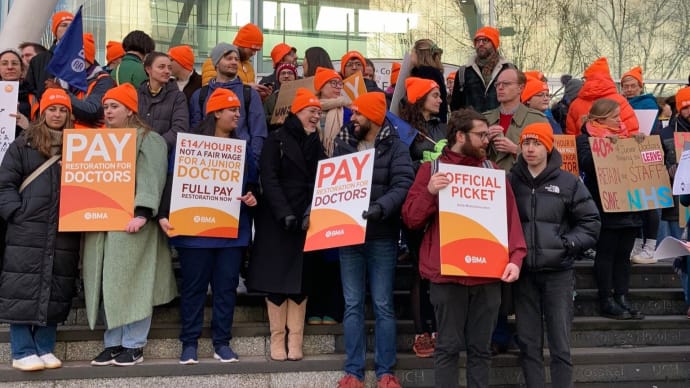
Trainee doctors strike in London on 20 December 2023. Photo: Ellie Philpotts
Trainees in Wales are also set to strike in January, while trainees in Scotland concluded action after accepting a 12.4% pay rise in August.
Whether this new period of action by trainees in England will be enough to force the government’s hand to deliver a better offer, and whether consultants and SAS doctors accept their deal, is anyone’s guess.
But our huge survey of over 7,000 Doctors.net.uk members in August showed most believed strike action in England could continue until at least the next general election.
T is for… Twenty-five years of Doctors.net.uk
It was a proud year for Doctors.net.uk and its community as we celebrated a quarter of a century of the site.
Founded in 1998 and the brainchild of Dr Neil Bacon, Doctors.net.uk is the largest and longest running platform of its kind in the UK.
We took a look back at some of the landmark moments in the site and the NHS through this time (given it was also the 75th anniversary of the NHS this year) and heard some heartwarming tributes from members.
U is for… Uncovering little-known features of Doctors.net.uk
How well do you think you know this website and all it has to offer?
In our 25th year, we also explored ten features or parts of Doctors.net.uk you may not have stumbled across yet.
The article was so popular we did a follow-up, where we looked at 11 more things you didn’t know you could do on the site.
Check out the tips to learn how to get unlimited email storage, navigate a map of members’ holiday homes to rent, save content to read later with My Medical Bag - and much more.

iStock.com/PIKSEL
V is for… Virtual wards expand across the country
The expansion of ‘virtual wards’ accelerated this year as the government and NHS England sought to tackle spiralling waiting lists.
The aim is to give patients hospital-level care in their own homes, freeing up hospital beds for more acute patients.
Though virtual wards have been around for some time now, a new target was set in January of treating 50,000 patients a month using remote monitoring technology, up from 100,000 in the whole of 2022.
A professor of primary care e-health discussed the plans in an opinion article in February, saying virtual wards can be useful, such as for avoiding hospital-acquired infections and receiving care in a familiar environment.
But while the wards may be virtual, the staff required to support the patients are not - and that leaves a big question mark over the scheme at a time of workforce shortages.
W is for Whistleblowing concerns
We saw many stories about doctor whistleblowers this year.
But we also saw how concerned most doctors feel about the act of whistleblowing. A recent survey by the Hospital Consultants and Specialists Association, working with the ITV Tonight programme, found most hospital doctors believed that speaking up about patient safety concerns would jeopardise their careers.
The medical union said doctors see the system as “weak, fundamentally flawed and not fit for purpose”. A Department of Health and Social Care spokesperson said all NHS staff should be “supported to raise concerns, to ensure safe and high-quality services”.
X is for… X-ray education
A flurry of radiograph interpretation CPD resources landed in our Education area this year - from our Basic chest radiograph interpretation module (aimed at doctors in training), to our quizzes on abdominal and chest X-ray interpretation.
All authored by consultant radiologists and radiology registrars; all updated with the latest information for 2023; all free to access.
Check them out today and take a look at our wider Education offer for members.

iStock.com/digitalskillet
Y is for… Yet more patients waiting
The NHS in England continued to battle worsening waiting lists throughout the year - recent data showed a record 7.77 million patients waiting at the end of September.
The government has continued to blame doctor strikes for not meeting its pledge to cut waiting lists.
Yet, analysis by think-tank The Health Foundation in October found that strikes had led to 213,000 fewer completed treatment pathways - only 3% of the total waiting list.
A small drop in the numbers waiting in November, to 7.71 million, was described as “heartening” for staff by the Royal College of Surgeons. But it warned that “the target to eliminate waits of over 65 weeks by the end of March 2024 will still be difficult to achieve”.
Z is for… Zero tolerance of sexual harassment and discrimination
Medicine has a problem with sexual harassment and discrimination - according to the annual survey of trainees by the GMC in July.
New, optional questions completed by 28,000 trainees on discriminatory behaviour - such as unfair treatment or stereotyping - showed these are very much present in the workplace.
Over a quarter reported experiencing microaggressions, negative comments or oppressive body language from colleagues. This included derogatory comments or actions including eye-rolling, patronising attitudes, inconsiderate scheduling or negative remarks about differences.
Insults, stereotypes and jokes about protected characteristics aren’t uncommon: 28% of trainees had heard these, with 4% reporting it was daily or weekly.
Concerningly, 6% of trainees have experienced unwelcome sexual advances or comments, making them feel distressed.
This picture needs to change - and has prompted the GMC to include a zero-tolerance policy for sexual harassment in its new Good Medical Practice guidance that comes into effect in January. It says doctors “must not act in a sexual way towards colleagues with the effect or purpose of causing offence, embarrassment, humiliation or distress”.
This was soon followed by the first NHS sexual safety charter, with 10 pledges including commitments to provide staff with clear reporting mechanisms, training and support.
Time will tell if these initiatives can help to eliminate this behaviour from workplaces.
Contains content provided by PA. Copyright © PA Media 2023
Top image contains (clockwise from top left): iStock image by sturti, iStock image by Akarawut Lohacharoenvanich, iStock image by izusek, and image by Ellie Philpotts,
You might also like